
Agency: Scientific Interest Group (GIS) between industry and academia – High Energies in ADditive manufacturing (HEAD)
Instrument: GIS HEAD 2022
ID: GISTEAM3
Institutions: Ecole des Mines
Co-PIs: Yancheng Zhang and Manas V. Upadhyay
Core scientific team: Zixuan Li (Ph.D. student), Michel Bellet (Professor, Ecole des Mines), C.-A. Gandin (CNRS Researcher, CEMEF)
Dates: September 2022 – August 2025
Funds: 120,000 €
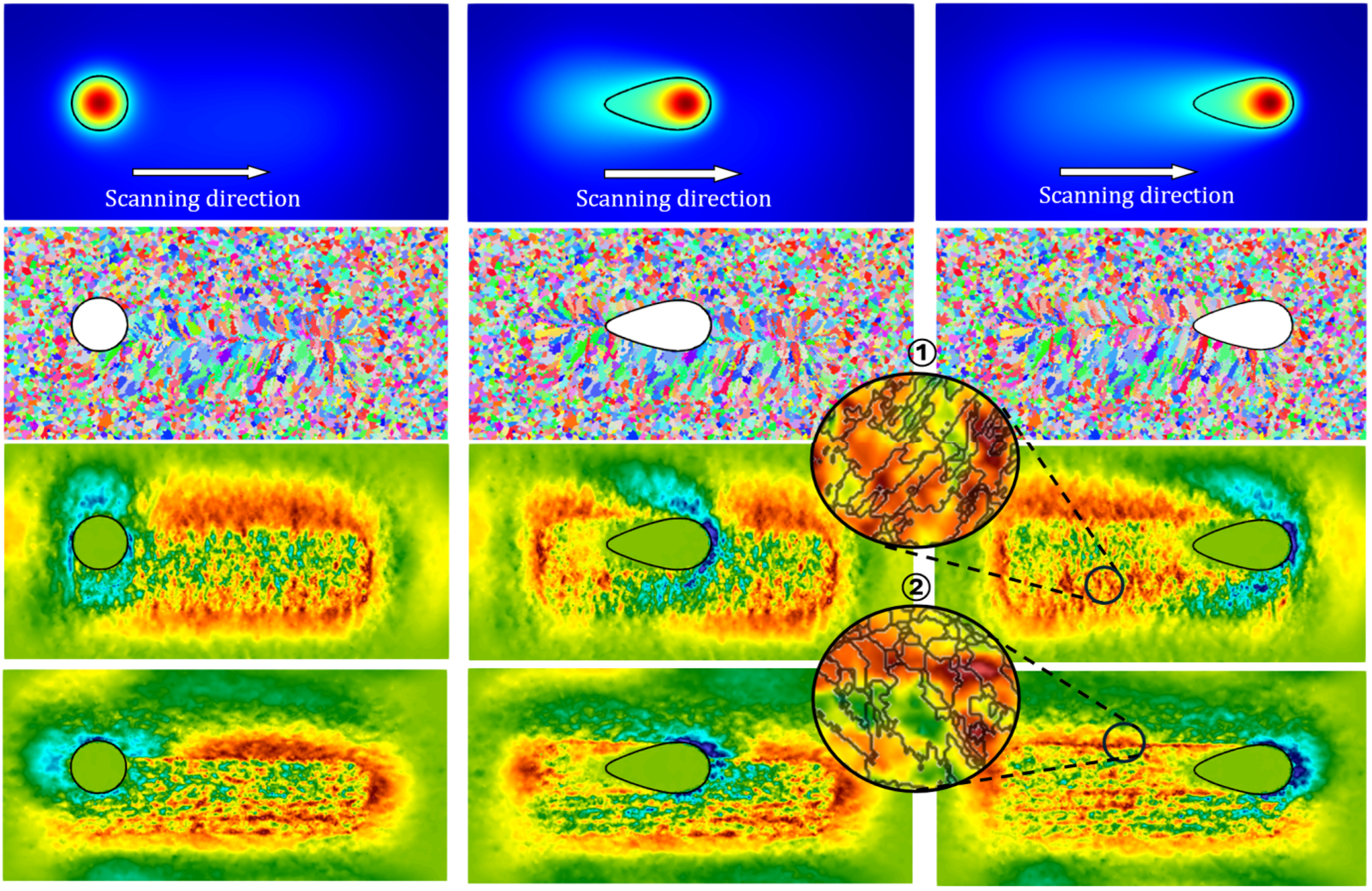
Aim: To establish an integrated experimental-modelling framework to understand and predict solidification grain structure formation and internal stress evolution during laser powder bed fusion (LPBF)
Objectives:
- Characterize grain structure evolution during LPBF at the track scale through CW Laser-SEM experiments.
- Develop a strongly coupled cellular automaton–finite element (CAFE) model together with crystal viscoplasticity to capture grain growth, stress evolution, and thermo-mechanical interactions during laser scanning.
- Validate model predictions using in situ and ex situ experimental data on 316L stainless steel, and simulate the influence of different scanning strategies.
- Establish a multiscale framework linking process parameters, grain orientation, and localized stress distributions in the mushy zone and solid.
Methods:
- Single-track laser scanning experiments on 316L stainless steel via CW Laser-SEM.
- Coupled CAFE–crystal viscoplasticity finite element modelling
- Calibration of the crystal viscoplasticity model using stress–strain data of annealed 316L, accounting for thermo-elasto-viscoplastic (TEVP) deformations.
- Simulation of multiple scanning strategies to investigate how process conditions influence stress localization and grain orientation.
Impact and Output:
- Delivered one of the first coupled modelling frameworks simultaneously resolving solidification grain growth and stress evolution during LPBF-like conditions.
- Demonstrated that stress concentrations develop preferentially along elongated grains and at orientation mismatches, providing insights into potential precursors leading to crack formation.
- Established a foundation for multiscale process–microstructure–mechanical properties investigations in AM, directly feeding into subsequent projects (IMP3D, LaserSurf).
- Peer-reviewed publications (1 already under review), dissemination in international conferences.