
Agency: Interdisciplinary Center for Defense and Security Studies (CIEDS), France
Instrument: Appel à projet (AAP) 2023
ID: LaserSurf
Institution: Ecole Polytechnique
PI: Manas V. Upadhyay
Core scientific team: T. Andrieux (Ph.D. student), M. Sazerat (Post-doc), A. Baganis (Post-doc), D. Weisz-Patrault (CNRS researcher)
Dates: Oct 2024 – Sep 2028
Funds: 699,712 €
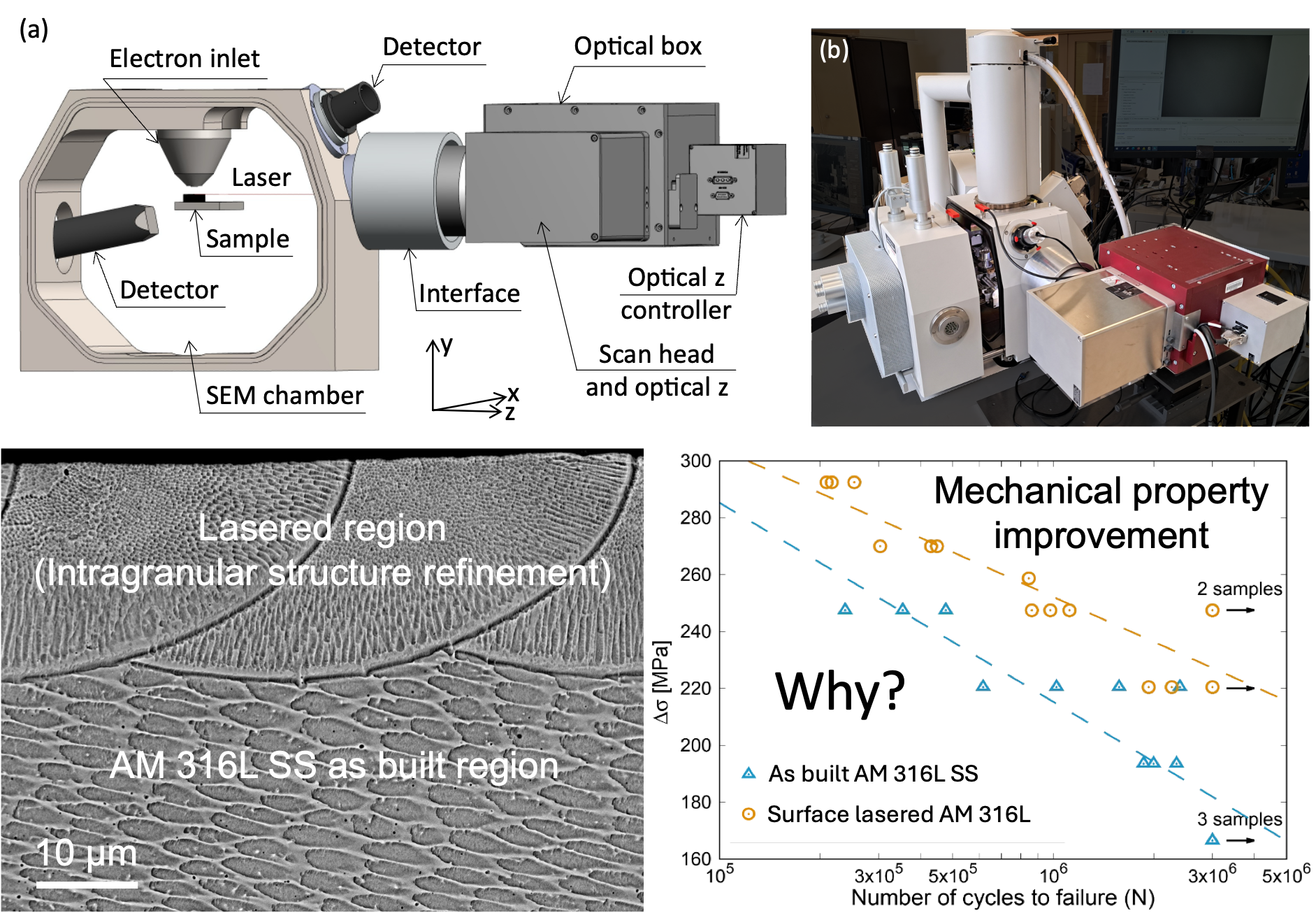
Aim: To develop rapid, energy-efficient laser surface treatments for AM steels and Ti6Al4V parts that significantly enhance fatigue and wear resistance and thoroughly understand the microstructural origin of these enhancements
Objectives:
- Evaluate various laser scanning strategies to minimize surface roughness and refine the microstructure close to the surface of AM samples.
- Quantify improvements in fatigue, wear, and mechanical performance resulting from high-vacuum CW laser treatments, especially on stainless steel and Ti6Al4V samples.
- Develop fast predictive models to link laser surface treatment parameters, resulting surface and subsurface microstructures, and performance under cyclic loading
- Integrate experimental efforts with ML to expedite optimization of laser parameters and establish protocols for industrial implementation.
Methods:
- Use high-vacuum CW Laser-SEM device to apply surface laser treatments on as-built AM specimens.
- Characterize treated surfaces by microscopy (optical, SEM), and hardness, fatigue and wear testing under controlled loading.
- Use laboratory XRD to obtain residual stresses.
- Model melt-pool dynamics and thermomechanical responses in treated surfaces using finite element and semi-analytical solutions to the thermomechanical problem.
- Fine tune foundational ML models using the labelled experimental data collected.
Expected Impact and Output:
- Improved durability of AM metal parts via enhanced surface performance for fatigue and wear, shifting the viability of printed components in demanding applications.
- Energy and cost savings via targeted surface treatment rather than full bulk post-processing.
- Trained ML model for surface treatments for the different alloys tested.
- Publications and presentations at conferences.